

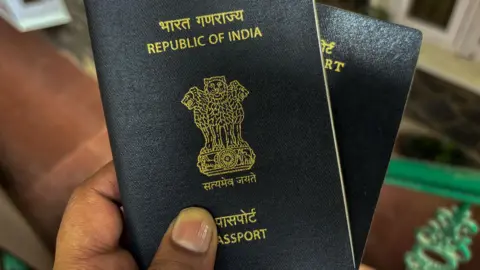
Earlier this year, an online clip from a popular travel content creator complaining about the limited power of the Indian passport gained massive traction on social media.
He mentioned that while nearby nations like Bhutan and Sri Lanka offered easier access of travelers from India, securing travel permits for visiting most Western and European countries remained a challenge.
This dissatisfaction with India's poor passport strength found confirmation in recent Henley Passport Index, ranking India at position eighty-five among nearly two hundred nations, a decline of five positions than last year.
The Indian government has not commented on the report so far.
Countries including Rwanda, Ghana and Azerbaijan despite smaller economic size than India – which is the world's fifth biggest economy – hold better positions on the index at the 78th, 74th and 72nd spots, respectively.
Actually, the country's position over the last ten years has hovered in the 80s, falling to ninetieth place two years ago. These rankings are dismal compared to Asian nations like Japan, South Korea and Singapore, all maintaining top positions.
What Passport Strength Measures
Passport strength indicates a nation's soft power and global influence. It also translates into enhanced travel freedom for passport holders, boosting business and educational prospects. A weak passport means more paperwork, higher visa costs, reduced travel benefits and extended processing periods when journeying.
However, even with the decline in the rank, the number of countries offering visa-free access to Indians has grown over the last ten years.
As an instance, eight years ago – the year Prime Minister Narendra Modi's Bharatiya Janata Party (BJP) came to power – 52 countries provided visa-free access to Indians with the passport at seventy-sixth position in the ranking.
The following year, it tumbled to the 85th position, then rose to eightieth over the past two years, declining once more to the 85th position currently. At the same time, countries allowing visa-free travel to Indian citizens increased from 52 in 2015 to 60 in 2023 and 62 in 2024.
Increasing Worldwide Travel Competition
The count of nations allowing visa-free entry this year (57) is higher than the number eight years ago (fifty-two), but the country's position for both these years is 85. What explains this situation?
Experts say that a major reason is the increasingly competitive landscape in global mobility – meaning countries are forming additional travel agreements for their populations' advantage and their economies. According to a 2025 report, the worldwide mean number of destinations people can visit visa-free has almost doubled from 58 in 2006 to one hundred nine currently.
As an illustration, The Chinese passport has expanded the number of visa-free countries its citizens can travel to from fifty to eighty-two over the last ten years. Consequently, its rank on the index has improved from ninety-fourth to sixtieth during the same time period.
Meanwhile, The Indian passport – which was ranked 77th on the index during summer – dropped to the 85th position in October after losing access to two countries.
Other Influences Impacting Passport Power
An ex-diplomat from India says multiple elements influencing the strength of a country's passport, like economic and political conditions as well as its openness to accepting travelers from other countries.
For instance, the American passport has fallen from the top ten and now occupies the 12th position – its lowest ever – because of its increasingly insular stance in global affairs.
The diplomat mentioned how in the 1970s, Indians enjoyed visa-free travel to numerous European and Western nations, though this shifted after the Sikh separatist movement in the 1980s. Subsequent political upheavals have continued to damage at India's image as a stable, democratic country.
"Numerous nations are growing more cautious regarding migrants," the diplomat added. "The country possesses a large quantity of people migrating overseas or remaining beyond visa limits and that interferes with the national image."
Factors like the security level of a national passport and immigration processes also contribute in gaining visa-free entry to other countries.
Security and Technological Improvements
The Indian passport remains vulnerable to security risks. Last year, law enforcement arrested 203 people for alleged visa and passport fraud. India is also known for cumbersome immigration procedures with lengthy timelines for visa approvals.
The diplomat indicated that technological advances, such as the newly introduced electronic passport or e-passport, can improve security and streamline immigration. This electronic document includes a small chip holding biometric data, making it harder to forge or tamper with the passport.
However, more diplomatic outreach and travel agreements remain key to boosting international travel freedom for Indian citizens and, by extension, the Indian passport's global position.


